Wednesday, July 6, 2016

Take Two Calf's Feet


From Dishes Mother Used to Make, 1941


TAKE TWO CALF’S FEET
by Terri Griffith
(This essay originally appeared in Connotation Press)

Like art, pornography, and love, everyone knows the meaning of the term “from scratch.” And just like these other words, when pressed, the definition is as hard to wrangle. The term is contextual, shifting meaning depending on who says it and when. I’m an adept cook, but I’ve never made puff pastry. I don’t know anyone who has. Even The Barefoot Contessa uses frozen, but I’m certain someone out there has a French grandmother who would rather starve than pull a box of frozen dough from her freezer. You can often find a big copper pot on my stovetop simmering chicken stock. I make salad dressing. I soak beans.
The meaning of “from scratch” was perfectly clear to me until one day when I was browsing the Culinary Arts Institute cookbooklet Dishes Mother Used to Make (1941). I wasn’t reading, just paging through looking at pictures. There was a photo of what I at first thought was dessert—star-shaped, gelatinous. The caption read: “This pretty mold of nourishing calf’s foot jelly is made by the same recipe as the one mother carried when she visited the sick.” It then became clear that I was looking at aspic. The revelation came not from the ingredient list or attendant photo, but somewhere in the middle of the directions when I realized that the calf’s foot in “Calf’s Foot Jelly” was the source of the gelatin. It was stupid not to understand this immediately; earlier cooks would have.
But I’m not an earlier cook. To me, gelatin in its virgin state comes from a small orange package of Knox or if I’m lucky, a professional cook’s box of gelatin sheets. I should know better. Still, I find it difficult to imagine the average contemporary home cook rendering gelatin “from scratch.” Then again, what recipe from the last hundred years would have us boiling calf’s feet? Effectively, a box of Knox is from scratch, in that it is the least processed version of the ingredient available.
In the I Love Lucy episode (1952) entitled “Pioneer Women,” after figuring out that Lucy has washed more than 200,000 dishes in the ten years since her marriage to Ricky, Lucy and Ethel decide they want automatic dishwashers:

Ricky (to Fred): Isn’t it amazing how spoiled modern women are?
Lucy: Spoiled?
Ricky: Yes, spoiled. You think you got to do a little work and you’re hysterical.
Lucy: A little work!
Ricky: Why honey, this is the electric age. All you have to do is flip a “swish.”
Lucy (to Ethel): We flip a “swish.”
Ricky: Your grandmother didn’t have none of these modern electrical conveniences and they not only washed the dishes, they swept the floor, and churned the butter, and baked the bread…they made their own clothes.
Lucy: Sure and where are those women today? (pause) They’re dead!

So Lucy and Ethel bet Ricky and Fred that they can all live as people did in their grandmothers’ time. They choose the date 1900 as the cut off and if the women can keep to the “Gay 90s” then they can have the money for dishwashers. Although their conversation is framed around the idea of technology, the show comes down to a parsing the concept of “from scratch.”
You don’t even have to watch this episode to know what happens—Lucy and Ethel spend the rest of the show trying to make bread and butter. As you’ve probably guessed, they were unsuccessful. Lucy is unfamiliar with bread making and relies solely on a cookbook to guide her. At one point she describes to Ethel what kneading is. Precisely because she has no idea what she’s doing, she finds that she’s used thirteen cakes of yeast instead of three.
            It is Fred’s grandmother who churned butter, so we know from this that she must have lived somewhere rural with access to large quantities of cream. Making butter from store-bought cream doesn’t make good economic sense. As Ethel says sarcastically of the half or so pound of butter she has just churned, “Imagine, all that butter and it only cost me twenty three dollars and seventy-five cents.” And that was in 1952.
            Ricky’s bread-baking grandmother lives in Cuba, and as he mentions on another episode that his family are farmers. This is a significant difference not in era, but in culture. Lucy and Ethel live in New York City, in apartments. They are show people: the Mertzs, retired vaudevillians, and Ricky Richardo, a bandleader. In later episodes, the Richardos own their own nightclub. Both the Mertzs and the Richardos are childless, at least in this episode. Even in 1900 it seems unlikely that these women would have baked bread, much less churned butter. Neighborhood markets were abundant, bakeries close, fresh dairy delivered daily. Judging by Lucy’s complete lack of knowledge about bread making, no woman in her family ever baked a loaf of bread anywhere in her vicinity. For women like Lucy and Ethel, meals comprised of fresh bread from the bakery and milk-man delivered butter were from scratch.
On the Food Network show Semi-Homemade Cooking with Sandra Lee (2003), our hostess schools us in the assembly method of cooking. Her website states: “Sandra Lee’s trademark 70/30 Semi-Homemade philosophy combines 70% ready-made products with 30% fresh, giving everyone the confidence to create food that looks and tastes from scratch.” For Sandra Lee the definition of  “from scratch” is rather generous. Lee asks us to reassemble food that has arrived in her kitchen already in varying states of readiness. The “homemade” in Semi-Homemade Cooking often does not point to what serious cooks would refer to as “from scratch” ingredients. In her recipe for “Mexican-Style Macaroni and Cheese,” Lee has the cook combine boxed macaroni and cheese with “Mexican” seasoning, finally topping the whole thing with packaged, pre-shredded Mexican cheese blend. In this recipe, I can only imagine that the fresh ingredient would be the cheese.
But to be fair to Lee, it is not food that purports to be healthy or nutritious. Lee is selling something else. She is selling love. We can see this from the cocktails and tablescapes she constructs each week. The subtext of every episode of Semi-Homemade Cooking is, If you take these ingredients and fabricate them into something recognizable as food, you will demonstrate to your family how much you love them. In this way, Sandra Lee’s recipes, however misguided we may think them, are successful.
Famed cookbook author and former owner of The Barefoot Contessa gourmet food store from which she takes her nickname, Ina Garten makes a living cooking mostly from scratch and showing us how to as well. Her cookbooks are slick and appealing. Hardcover, with big, beautiful pictures, of healthful, lovingly prepared dishes. Although Barefoot in Paris is one of my favorite cookbooks and contains recipes for “French Lentil Sausage Soup” and “Palmiers,” it also contains recipes for things like “Roasted Beets,” which is simply…well, roasted beets. In her other cookbooks you can find similar recipes for “Roasted Winter Vegetables” and “Roasted Carrots.” These are fine recipes and suggest things like the addition of thyme or a splash of vinegar, but they are essentially recipes for dishes that don’t need recipes. These are simple foods, which is exactly the point Garten is trying to make—That wholesome ingredients and simple preparation are all that are needed to create an outstanding meal. Even in the picture of the humble roasted carrots, the carrots are seductive and slick with olive oil. The photo is pornographic in its detail and explicit availability, the shards of fresh cracked pepper and grains of kosher salt large enough to see.
            Like Lee, Garten is a contemporary cook. She does not expect her readers to make puff pastry, nor does she expect us to make our own mayonnaise, though she does recommend specific brands. Whether this is intended or not, this recommendation of store-bought products reminds home cooks that we are not making every element of this dish from scratch. What she does is strip away the layers of processed food that we have grown so used to eating that they have become nearly invisible. This has the effect of throwing the few remaining processed items into stark relief against their elemental brethren: carrots, beets, a whole roast chicken.
            How do we define what is from scratch and what is processed? Is flour processed? Cheese? Sausage? Canned chickpeas? Organic free-range chicken stock? Unprocessed sausage is just meat and where’s the fun in that? And what’s the difference between the bag of pre-shredded, “Mexican” flavored cheese blend, and a ball of goat’s milk cheese from my local natural cheesemonger?
This cultural move to deconstruct food into recognizable components is central to both The Slow Food and Localvore movements. But we see this idea reflected in the general consumer market as well. In a Tostitos ad, a woman (played by a youthful Meghan Markle) who is shopping for her upcoming party is perusing the chip isle while her thoughts run as a voiceover. She thinks about chips and how much she doesn’t like one of the potential party guests. The ad ends with her looking at a brown, natural looking bag of corn chips, which contains thirteen ingredients. She then picks up a bag of Tostitos and the voiceover says, “White corn, vegetable oil, salt. Yeah, three ingredients is good.” Suddenly these Tostitos Scoops are recontextualized as wholesome solely because they are simple, made of ingredients we can all understand. In the 1990s “white corn, vegetable oil, salt” would have read as a list of foods to avoid.
            I am sure there are those who mill their own grain, as I am sure there are those who make puff pastry from scratch, still for most people a bag of flour is an elemental ingredient. It’s our renewed desire to know what we are eating—where it comes from, the quality of ingredients, how it was produced—that makes a short ingredient list a selling point. Whether or not home cooks will return to rendering gelatin from hooves has yet to be seen. But with the ways things are going, it seems likely.


WORKS REFERENCED:
Berolzheimer, Ruth. ed. Dishes Mother Used To Make. Chicago: Culinary Arts Institute, 1941. Print


Garten, Ina. Barefoot Contessa Back to Basics. New York: Clarkson Potter, 2008. Print

The Barefoot Contessa Cookbook. New York: Clarkson Potter, 1999. Print

Barefoot Contessa Family Style.  New York: Clarkson Potter, 2002. Print

Barefoot in Paris. New York: Clarkson Potter, 2004. Print


“I Love Lucy.” The Museum of Broadcast Communications. Web. 11 Feb. 2010.            .


“Knox Gelatine.” Kraft Food. Web. 12 Feb. 2010. .


“Pioneer Women.” I Love Lucy: The Complete First Season. Original Air Date, 31 Mar. 1952. Paramount, 2005. DVD.


Semi-Homemade Cooking with Sandra Lee. The Food Network. Web. 12 Mar. 2011            http://www.foodnetwork.com/recipes/sandra-lee/mexican-style-macaroni-and cheeserecipe/index.html.


“Unwanted Guests.” Goodby Silverstein & Partners. Web. 18 Mar. 2012.
http://www.goodbysilverstein.com/#/work/tostitos_dips_and_chips_unwanted_guests_broadcast.

Wednesday, March 23, 2016

Vote for Gracie!

My writing partner, Nicholas Alexander Hayes, and I have a new essay published in PopMatters. It's a look back at Gracie Allen's run for President in 1940. Check it out! What ever happened to campaign songs, anyway?

Thursday, March 17, 2016

How to Help Your Husband Get Ahead


I enjoyed The Beginner Housewife (1956) so much that I have decided to read all of the books advertised on the back of the book jacket. First up, How to Help Your Husband Get Ahead In His Social and Business Life, by Mrs. Dale Carnegie. If the name sounds familiar, her husband, Mr. Dale Carnegie is the author of How to Make Friends and Influence People (1936). First of all, let's be real. Mrs. Carnegie, I am positive you have a first name of your own, though the "Mrs." does really highlight the married thing. I was pretty dubious about the claim this book was making right in the title. I thought, What if my husband is a total loser? Luckily, Mrs. Carnegie addresses this in the first chapter.  She says, "Professional social workers, psychiatrists and other specialists may object that the rules I have formulated will not work in every case. What about husbands who are drunkards, drifters, ne'er-do-wells and congenital misfits? (3). I don't really know what to do if your husband is a drunkard or ne'er-do-well. I guess you have to get a different book.

This book is filled with all the sexist crap you might expect. You should cut your husband a ton of slack. Let him go out with his male friends. Stay off his back, even if he stays out all night. But there was also some very thoughtful passages as well. She urges wives not to be jealous of the women who work in the office or your husband's secretary. They're at work making their living--presumably because they don't have husbands who are as good of a provider as your husband is. I thought that was pretty open minded advice for the time.

I thought I was really going to hate this book. Seriously, it has all the hallmarks of something I would despise, but I was actually surprised. My "husband" is my wife and I just assumed there would be little for me. But I found myself, directly after reading this book, drawing on some of Mrs. Carnegie's wisdom. My partner travels a lot for work. I mean, sometimes A LOT. I get lonely and have to watch Columbo and The Dick Van Dyke Show and sometimes eat potato chips for dinner, even though I know it's just going to make me feel bad. So when my partner said she had to go to an "emergency" meeting, I was just about to protest. Then Mrs. Carnegie's words came to mind. She asks wives to keep the complaining and the disappointment to themselves. Traveling is hard. No one wants to be gone all the time. Traveling is part of my partner's job. Actually, a pretty cool part and I don't want to make her feel bad. If I did make her feel bad, there's really nothing she could do about it anyway, so why do it. As my friend Rosa says, "It's time to put on your big girl panties." This is sound advice. Mrs. Carnegie couldn't have said it better.

(I stole this cute photo from PEAKaBooDesign on Etsy. My book had no cover.)


Thursday, February 4, 2016

Man's Favorite Sport


Last time I was at Audio Archaeology, I asked the owner for a recommendation for what I was then calling "White People Music," before I knew the term "Beautiful Music." He pointed me to this excellent record, Dear Heart and Other Songs About Love (1965), by Henry Mancini. It's choral music, sort of. It sounds a lot like supposed Jazz Choir from back in the 70s.

The songs on this record are terrible! They say terrible things about "love" and relationships. There's a cover of "Frankie and Johnnie," which is really the kind message we should be sending people about relationships. "Mr. Lucky" is pretty okay, because at least this "lucky guy" recognizes how awesome is "lucky girl" is. I actually think that the Everett High School jazz choir might have performed this tune.

One song was so upsetting to me that I had to Google it. "Man's Favorite Sport." Here is a sample:

Verse:
Some men say Judo is their dish
While others fish where mountain waters swirl

Chorus:
But let a girl appear, he'll pursue her
And run his fingers through her curls
And that's the way it's been since the world began
The favorite sport of men, is girls!

There is just so much wrong with this song. First of all, the verses are just lists of sports. They are solitary and elitist. But then these sports are compared to forming a lasting relationship with a woman, as if it is a competition. But maybe a lasting relationship isn't exactly what the man wants. Then there's the bit where the males are "men" and the females are "girls." Really? My Googling led me to learn that this is the theme song from a 1964 film of the same name, directed by Howard Hawks and starring Rock Hudson and Paula Prentiss. This film is clearly one of those awesome 60s sex comedies that I love so much. Seeing that it stars the queer-as-a-three-dollar-bill Rock Hudson, my opinion of this song changed. I think it was written to be intentionally campy. I can only hope. Still, it's pretty messed up.

Thursday, January 28, 2016

Library of Vintage Cocktail Books

Last Christmas I stumbled upon this book on Pinterest called Bacchus Behave!: The lost art of Polite Drinking. I felt certain that this was THE perfect book for my friend Nicholas. He loves spirits, loves Bacchus, and just hates exclamation points. Anyway, I set about trying to buy this book and people wanted hundreds of dollars for it--which might I say, seems worth every penny. Sadly, I did not have this many pennies in my holiday budget. But the interwebs, she just gives and gives. In my search for something object-ey, I instead found something entirely more vast and digital-ey. I stumbled upon the EUVS Digital Collection. This digital library contains I-don't-know-how-many scanned volumes of cocktail books. Their online reader is really amazing, making it possible to actually read and work from these texts. This collection appears to be the library for the Exposition Universelle des Vins et Spiritueux. In addition to cocktail books, there are also books on customs and glassware. Really, this is such a finely curated library it's worth your time to check it out even if your idea of a cocktail is a bottle of beer.


Saturday, January 23, 2016

Beautiful Music

Today my friend, Stephanie, took me to Madam Zuzu's in Highland Park. It's the second time we've been there. Mostly it's a tea shop, but it has records, too. I found this lovely album by Jackie Gleason called Music, Martinis, and Memories. As you can see, the cover is amazing. On the back it reads: music, martinis, and memories...each creates a wonderfully soft, romantic haze. This makes it sound kind of like Gleason is going to get me drunk and take advantage of me.

Until this afternoon, I had no idea that Jackie Gleason had anything to do with music. There were no liner notes and the text on the back was of little help, so I turned to the trusty Wikipedia. Apparently, Gleason just willed these albums to happen. He didn't play on them and wasn't the producer exactly. It's more like he said, "hey, make a record that will help me get lucky this weekend." Et voila! My new favorite record. Wikipedia called this record "mood music." It was hyperlinked, which I thought was pretty odd. Turns out this music genre actually has a name: beautiful music. I have a big collection of this music. At my favorite local record shop, Audio Archaeology, I just usually go in and ask the man at the counter if he has any new White People music. He hooked me up with a great Henry Mancini album called Dear Heart and Other Songs About Love. Most of the songs are pretty messed up. Now that I have these key search terms, the world of beautiful music is my oyster. Music, Martinis, and Memories is on Spotify if you want to listen to it.

Friday, January 22, 2016

The Beginner Housewife

The charming librarians at The School of the Art Institute of Chicago's Flaxman Library got me this awesome book, The Beginner Housewife via inter-library loan from, Guess where? New Zealand! I did for a moment question using the school's resources to procure this book for me. I read the book cover-to-cover, which took about two hours. I lingered. It was short and easy to read. Maybe the "Beginner" referred to reading level and out there somewhere there is The Intermediate Housewife and The Advanced Housewife. There's all sorts of tasties in the table of contents, from the basics of planning your day to the mysterious "masculine mending."

The thing that really struck me about this book is the publication date. It says 1956, but the advice in it seems really old. For example, the book talks about "if you are lucky enough to have a refrigerator." Really, by 1956 I would think most people would have had a refrigerator. By 1956, I would think a refrigerator would not be considered a luxury and that the lack of one would be seen as just that, a lack. It doesn't take very long for appliances of convenience to move from luxury to necessity.

Perhaps related to the refrigerator is the section that covers keeping a "stock-pot." I realize this is a time-honored tradition, but I was pretty surprised to see it in a book this recent. If you'd like to keep a stock pot here's some helpful advice:
1. Keep it covered.
2. Boil it up every day.
3. Never put anything into it but meat (including gristle and bacon rinds) and bones (fresh or cooked).
4. Empty it out daily and clean the pan thoroughly. (64)
I'm not so sure about this...

Overall the book was delight and I actually picked up some helpful hints. I found the
breakfast section really interesting because it included a lot of tinned fish. That would go over big in our house. Despite the total cuteness of this book, it's hardly been checked out.

The back jacket advertises a couple of other books. One is How To Succeed at Business Without Really Trying, which might actually be my favorite movie. It's certainly my go-to when I feel stressed out. I've already put on hold How to Help Your Husband Get Ahead, by Mrs. Dale Carnegie. I don't have a husband, I have a wife, but it couldn't hurt, right? The last book they advertise is The Secrets of Happiness. I'm not so sure about that one either.

Thursday, April 12, 2012

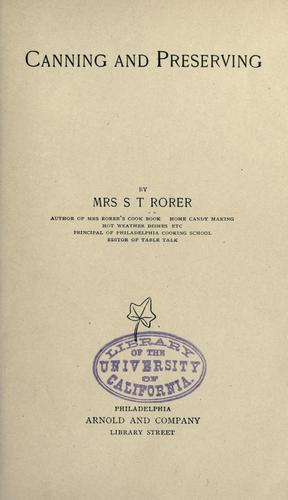
Canning and Preserving

What I'm currently reading on Google Books. 

From Canning and Preserving 
by Mrs S.T. Rorer, 1897

PREFACE

In this age of adulteration we know not what we eat, and as canning is so simple an operation, it is unfortunate that so many people use food put up at factories, consequently the author sends this little book out as a missionary, with a wish that it may remedy this evil, and prove both helpful and acceptable.
     The maxim that "practice makes perfect" applies admirably to preserving. While the recipes contained herein are as simply and explicitly described as possible, to insure perfect success time must not be considered and the greatest care taken.

SARAH T. RORER

Monday, April 9, 2012

Asparagus! The Pickled Kind


Spring has sprung! And if I didn’t know this from the lovely sunshine, I’d know it by the bounty of asparagus in the supermarket. I’d been planning for a while now to try my hand at pickling asparagus. I even bought some asparagus last week, but it didn’t make it to pickles, but instead into the oven for a lovely roasted asparagus side dish for friends.

Pickled nibbles are a cocktail party mainstay at our house. The thing is, I like my pickles to all taste distinctive. My friend Andrew and I made pickled okra last year, of which I have only a single jar left. They are tart and mild. A couple of months ago I made pickled carrot spears that are spicy, but tempered by sweetness. I wanted these asparagus pickles to have their own personality.

I’m not exactly new to canning, but still after all these years, I’m timid about straying from the recipe. You know, botulism, all that. I looked all over for a recipe that I both trusted and met my criteria. I wanted a simple pickle and I also wanted to can in quart jars because my asparagus was tender, long, and thin. For Christmas, my mom got me the book Canning for a New Generation. This book is great and one of the things I like most about it is that she often uses cider vinegar, which I find to have a gentle flavor. But the recipe was for pint jars and I wasn’t sure of the timing. Finally, I found a great handout from a great source—Washington State University! This freakin' great brochure has a handy guide that talked about vinegar and swapping out spices. It was great and gave me guidelines and confidence to adapt the recipe to my own needs.

PICKLED ASPARAGUS
Adjusted for Two Quarts

Brine:
1 quart cider vinegar (5%)
1 quart water
¼ cup pickling salt

Per jar add:
1 clove garlic
a few peppercorns
sprig of dill

Wash asparagus under cool running water. Cut spears to fit jar leaving ½ inch head space. Combine water, vinegar, salt to make brine. Heat to boiling. Pack asparagus into hot jars with tip ends down. Add garlic to each jar. Cover with boiling bring to within ½ inch form top of jar. Finger-tip tighten lids.

Process in boiling water bath for 10 minutes for pints or quarts, 15 minutes for 1,000-6,000 feet elevation.


Sunday, January 29, 2012

All Hail Kale!

Well, it's that time of year again, the time of the year when my weekly Newleaf produce box is full of kale. I love kale, but it does have a way of building up in the fridge. I have a few recipes I make a lot where the kale is cooked, like Gourmet's potato and kale gallette or the ever popular black-eyed pea, kale and chorizo soup. Sometimes, though, I like to use the kale raw.

Usually, I'm meticulous about keeping track of the source of my recipes, but this is a recipe I found at my sister-in-law's. I snapped this photo, certain that I would remember where it came from. But guess what? I don't. Anyway, I've made this recipe a couple of times and it's fantastic. A little browsing on the interwebs reveals this to be a traditional Italian salad. The real key to this salad it to shred the kale thinly. I love this salad. It's cheap, healthy and elegant.

Tuesday, January 24, 2012

A very Gourmet New Year's round-up, 2001 style!

I'm not sure about you, but so far my resolutions are going pretty well. As part of this year's get better plan, I vowed to clean out that stack of papers that's been moving around my house for about a year now. First here, then there. You'll be glad to know it's gone now...well, mostly. One of the gems I found in this pile was this list of the 50 best restaurants of 2001. I don't remember cutting it out, but I did. And it's only taken me 11 years to figure out what to do with it. So I thought that before I toss this in the recycling, I'd share it here on the interwebs. It's a good list. Many of these restaurants would make it on the list today. My only regret? That I didn't make it to the Herb Farm when I lived in the Pacific Northwest. Oh well, at least I have Topolombopo and Blackbird.

Friday, January 13, 2012

Google eBookstore

I’ve fallen down the rabbit hole of Google’s eBookstore. If you move past the first page of bestsellers and serial fiction, you’ll find a ton of digitized magazines from the past. My friend Meg Onli is doing a project based on Black World / Negro Digest magazine, but if you go back a hundred years earlier you’ll find a wealth of ladies’ journals from the 1800s. My favorite are Godey’s Lady’s BookAmerican Cookery: The Boston Cooking School Magazine (of Fannie Farmer fame), and my favorite, The Delineator.
    The Delineator is the magazine produced by the Butterick company from 1873 to 1937. If the name Butterick sounds familiar, it might be because they’ve been making sewing patterns since the mid-1800s. You can still buy them today. In fact, The Delineator’s main purpose was to introduce current fashions and then show you how you might reproduce the same at home with the aid of a hand dandy Butterick pattern. If you ask me, the clothes look so complicated I couldn’t imagine getting dressed by myself. Making those clothes seems impossible! The ongoing discussion of fasteners and safety pins is fascinating, and there is always a section on at-home millinery in case you want to make your own hats.
    The other thing that’s so interesting about The Delineator is that it is also the acorn from which spring the tree of the Culinary Arts Institute. Every issue of The Delineator contained recipes as well as general tips on cooking and housekeeping. The articles are fun as well.
    One of the great things about Google ebooks is that they are full scans of the magazines. This means you get all the amazing ads as well. It’s through this ephemera that I can see into the past. History books never meant much to me, but to be able to read what women of the time were reading, is fascinating. Today I saw a young women reading a crappy entertainment magazine about the Oscars and wondered if Google were to digitize that, what would readers a hundred years from now think.
    Although it’s great fun to read these magazines, don’t look for them to be easy academic research. The metadata is sucky, magazines are called by different titles depending on what source digitized them. Most of the ones I have run across are scanned in volumes, which on the surface seems easy, but really makes it hard to find things again, especially because the pagination of the journal does not match the pagination of the scan.

Friday, January 6, 2012

Scalloped Potatoes

You know what's good? Potatoes are good. I mean, they are so yummy it's hard to even fathom it. I recently made Scalloped Potatoes from pretty much my favorite of the Culinary Arts Institute cookbooklets, 250 Ways of Serving Potatoes. You might remember a similar dish that my friend Stephanie made for The Culinary Arts Institute dinner party back in 2009. This is not the same recipe, but from the same chapter of the same book. I reread her suggestions before I started this one. But really, it's potatoes and butter. How bad can it be?

SCALLOPED POTATOES
6 medium potatoes
salt and pepper
2 tablespoons flour
4 tablespoons butter
milk

Pare potatoes and cut into thin slices. Place in a greased baking dish in 3 layers 1 inch deep, sprinkling each layer with salt, pepper and flour and dotting with butter. Add milk until it cane be seen between slices of potato, cover and bake in moderate oven (350 F) until potatoes are tender when pierced with a fork, 1 to 1 1/4 hours. Remove cover for the last 15 minutes to brown. Serve from baking dish. Serves 6.

I fancied-up the top so it would look Frenchified. But if there's one thing I have learned about CAI recipes is that the potatoes always cook longer than it says. I'm pretty sure this isn't the sort of thing where people in the past liked their potatoes toothier either. It's something else that I just can't put my finger on. Perhaps oven temp? Maybe I should have cooked it at 375. One thing I did account for was the use of the word "milk." Nowadays, we have all kinds of milk. I assumed they meant whole milk, which I didn't have, so instead I used half two percent and the remainder half and half, which is a common substitution. It ended up baking nearly two hours, but I'd planned for that. All in all, this was an easy recipe and the potatoes were crazy good. Even better the next day. We had it warmed up with a salad for lunch. I'd certainly make this again.

Sunday, October 16, 2011

Gourmet All the Way!

For about two years now, I've been collecting back issues of Gourmet. At first it was just an issue here and there. Then I bought five years off eBay from 1961 through 1965. These magazines served me well. My favorite thing this last two summers has been to go to Ravinia, sit on the lawn with a pick-nick, a glass of wine, and a forty year-old issue of Gourmet.

Well a few weeks ago I was looking at eBay and saw that a woman had put up for sale her whole collection of Gourmets. From 1965 all the way through the last issue. This just about killed me. I was intentionally NOT trying to make a complete set of Gourmet. I mean, our apartment is 697 square feet. Where am I supposed to store something like that? And what kind of right do I have to take up all of that space? Who needs all those magazines anyway? Turns out I do because I wrote the woman. She'd never sold anything on eBay before. Her mother-in-law had subscribed to the magazine and when she passed, this amazing woman kept renewing the subscription. I can see how that happened.  It would take a lot to stop subscribing after all those years. Perhaps like a monthly remembrance of her mother-in-law.

The catch was, I had to pick the magazines up in Kentucky! I just couldn't figure out how to make that happen, so I didn't even bid on them. But no one else did either. When the magazines were reposted Serena convinced me to buy them. The woman who was selling them offered to meet us in a town called Marion on the Illinois side of the boarder. This saved us two hours each way.

I was really nervous to meet her. I was afraid she would think me a dilettante. Or perhaps resentful that I was carrying away her past. But when we all rendezvoused in the parking lot of some highway-side chain hotel, all of my fears were dispelled. Her name is Terri! And she's an artist and a metal worker and someone who, if I'd met at an opening, I would have immediately loved. The whole experience was odd and intimate. I felt as if I were carrying away her memories, which I guess I was.

After almost a week of rearranging, cleaning, and tossing out, finally the magazines are installed in the dining room. This was at Serena's insistence. She maintains that after the time and expense of procuring these things, it would be foolish to stash them in the basement, or even under the bed. Of course, she is right.

I've got some duplicate years. Now I'm the one posting on eBay.


Sunday, October 2, 2011

The Lunch Box


Last weekend Serena and I drove practically to Kentucky to pick up 54 years of Gourmet that I bought off Ebay. It’s a six hour drive to Marion, where we were to rendezvous with my Gourmet’s previous owner. But six hours is a long time in a car and although we had a good time, but doubt we’ll be vacationing there anytime soon.

Since I’d already shot my wad on the magazines, this road trip seemed like perfect opportunity to try out some new recipes instead of eating at a lot of expensive and unhealthful roadside restaurants. I turned to The Lunch Box Cookbook for some ideas. I settled on “Sardine de Luxe” filling for our sandwiches. But quel dommage! I was all out of sardines. Serena though that this was a good thing, and that perhaps sardines sandwiches weren’t quite the right choice for a day-long car ride.

Of course she was right, and I decided to make something that did not require a trip to the grocery. The Lunch Box has a great recipe for “Basic Egg Salad Filling” followed by many “variations.”

4 hard-cooked eggs, chopped fine
3 tablespoons chopped sweet pickle
3 tablespoons salad dressing
   NOTE: they mean vinaigrette dressing
½ teaspoon prepared mustard
¼ teaspoon onion salt
Few grains pepper

This is an easy recipe and I had everything on hand—even onion salt. I chose the variation in which you add chopped pimento-stuffed green olives. It was really tasty and way less stinky than sardines.

Sunday, September 18, 2011

Roasted Artichokes


This week my Newleaf Grocery organic produce box contained two perfect little artichokes. I love artichokes so much, but the last time I made them I think I steamed them for maybe...I don't know, six hours, and they were still underdone. So staring at my new friends on the counter, I decided to try something new. After a little browsing on the interwebs, I came across this great recipe for roasted artichokes on the excellent food blog Pinch My Salt.

The recipe is simple enough: Cut the tops off your artichokes, stuff in a few cloves of garlic, drizzle with olive oil and lemon, then of course, salt and pepper. Wrap your little ones in foil and bake at 425 for an hour and fifteen minutes. This is one of the best and easiest recipes I've ever tried for artichokes. They are delicious and require zero attention, which would make them great and elegant for a dinner party, something where you don't want to be tied to the kitchen. 

I'd never roasted artichokes before, and I have to say, they are amazing. The roasting intensifies the flavors. Most likely, any artichoke at my house will never again see a boiling pot of water.

Sunday, September 11, 2011

Pin Feathers

I used to hate chicken—all chickens, including actual pecky chickens, and I especially hated poultry, the eatin’ kind. My only experiences with chicken involved meat that was stringy, dry, and dusty. All of that changed when I moved to Rogers Park and started ordering the whole roasted take-out chicken from El Llano. Sadly, it burned to the ground and I was forced to learn to make chicken myself. Don’t worry, though, they have another location.

America’s Test Kitchen is great place to start for almost any new cooking skill. After many attempts, I mastered their roasted chicken recipe, and can knock a Purdue extra-meaty roasting chicken out of the ballpark. But I’ve got to tell you, a big, fat, giant chicken takes a long time to cook and it makes every meal feel like Thanksgiving. A whole roasted chicken is feels a little limiting.

Then about three months ago, I moved to the advanced stuff—Jacques and Julia Cook at Home. Jacques likes to splay his chicken. This has a couple of benefits. First, it cooks in about half the time. Second, it makes the chicken seem WAY less formal. It’s easy to dress up or down. The knife skills needed for this are just at the outer edge of my ability, so I always make sure to watch Jacques do it right before I attack the backbone. Usually, I watch it two or three times to work up the courage to chop the joint off it’s little drumstick. Practice is helping. A cleaver might help more. I think the next step is to try boning an entire chicken.

In The Culinary Arts Institute Encyclopedic Cookbook, there’s a handy little boning how-to. Step 1 includes cutting the head off your chicken. My chickens only come beheaded. ALL of the recipes in the poultry section have you start by pulling and singeing pinfeathers. I get the feeling that chickens used to come barely dead. The pictures are great, but I’m not sure they’re that instructive. The last steps show you how to stuff and tie your now de-boned chicken. Makes me want to try it.

Wednesday, April 13, 2011

The New Art

Last weekend Serena and I went to the Edgewater Antique Mall. I was poking around the ladies' things, like I always do, when I ran across some excellent used books. I found the 1953 Pillsbury Bake-Off cookbook highlighting the year's winners (more about that later). I even thought about trying to enter. I mean, the deadline is this Saturday. I sadly discovered that I do not meet the requirements. Too bad. The Pillsbury Bake-Off seems like the kind of thing you could etch on a tombstone.

This delightful handbook The New Art (1935) is produced by the General Electric Kitchen Institute of Nela Park, Cleveland, Ohio. In it the authors introduce us to the joys of General Electric kitchen appliances. The book opens with a photo of the pastoral Nela Park GE Kitchen Institute. The following pages show happy, carefree women. In one photo a woman sits in a car stopped on what looks like a tree-lined street, while a woman on the sidewalk leans into her friend's car. They look as if they have just bumped into each other. The car door is open. Perhaps they are going somewhere. The photo that follows shows a well-dressed woman sitting on sprawling lawn as her children play next to her. The next photo is a foursome of women playing cards. It is obvious these women have been set free from the drudgery of kitchen work and are now able to spend more time with their children. But what's more surprising is that they are also depicted as child-free, spending leisure time with each other. The first part of this little booklet goes to great lengths to avoid showing actual women using the appliances. The only women we see using these new time-saving tools are disembodied hands and female scientists. The housewives, well they just drive around the neighborhood and play cards all day.

There's delightful little tidbits throughout. For example in the chapter entitled "Food Preservation and the General Electric Refrigerator," we are told how this new device solves the three major problems of food storage: "1. A low, even temperature, always below 50 degrees. 2. An atmosphere not too moist nor too dry. 3. A good circulation of of pure, chilled air." I don't know about you, but I'm shocked that 50 degrees counts as "chilled." Um, I think my bedroom closet runs somewhere around 50. 

One thing that all the appliances had in common is that they all have space beneath them. As Serena pointed out, that would go a long way to making a small kitchen feel spacious. I kind of wish we still had these today. I'd like them to work a little better, though.

The little booklet ends with these words: "The New Art of Living Electrically has not only banished drudgery and monotonous routine from America's homes, but is has brought new hours of freedom to the busy homemaker, new joy to her work, new savings to her budget, and new health and happiness to her family." Turns out they were right.

Sunday, March 6, 2011

Barefoot with Ina


Have I mentioned that I’m in love with Ina Garten? I mean really, really in love. I used to just read her cookbooks (Barefoot in Paris is my favorite), but then her show Back to Basics appeared on Hulu and that’s when I was really smitten. Her freckle-kissed nose. Her joie de vivre. The portrayal of life in The Hamptons that boarders on pornographic. It’s my favorite way to end the day.
Recently there was an episode where she made a dessert of roasted berries, finished with walnuts, served atop Greek yogurt. While I was watching the show, I didn’t really think much about it. But the next weekend, we were invited to our friends’ house for dinner, so Serena and I decided to try Ina’s dish. It was a big hit.

The thing is, I don’t live in The Hamptons, and for most of the year good berries are hard to come by. So, I bastardized Ina’s fresh fruit recipe and came up with something similar that I have been serving for breakfast all through the worst part of winter.

In a heavy skillet add about a quarter cup of water, just enough to wet the bottom of the pan. Add a diced apple and diced pear (or whatever it is you want to get rid of) and let these cook a few minutes on medium, just to soften them up a little. To this mixture I add about a half-teaspoon of cinnamon and a generous pinch of cardamom. Then I add a bag of frozen organic mixed berries. And if they are reasonably priced, fresh berries too. Right now organic blueberries are around for about 2.50 so they have been well-featured. I add a big pinch of kosher salt and the let whole thing bubble around together, until the many have become one, but not so long that the berries break down. When it is all over, stir in chopped walnuts. Serve on Greek yogurt.

This has been such a pleasant addition to our morning. Bright and sunny. It’s easy to make, too and has the ability to give new life to tired apples and pears.

Monday, February 28, 2011

Chou-fleur au beurre noir

Sometimes a dish sneaks up on you with its goodness. You make it, set it on the table, and then are dumbfounded by the result. This is exactly what happened to me last week as I was unthinkingly trying to get rid of some surplus cauliflower from my organic produce box. As you may know, I love cauliflower—actually all of the cruciferous vegetables: broccoli, cabbage, kohlrabi, Brussels sprouts, rapini, all of them.


A couple of weeks ago I bought a copy of LaRousse Gastronomique. The consensus of the interewebs said to get the pre-revision version, so I bought the 1961 edition. It’s not really a cookbook, but more of an encyclopedia of food. Each entry describes the food/dish/technique in detail and then gives practical examples. I was reading through the “C” section and stumbled upon “cauliflower” or chou-fleur as the French say. I read through all of suggestions for preparation and they sounded all right, but mostly involved boiling in well-salted water, serving either hot or cold and covering with something like cheese or butter or herbs.


Later that day, I’m staring mindlessly into the fridge trying to come up with something for dinner and I thought, What the hell. I’ll just boil that cauliflower up. So I followed the directions and boiled the head whole and topped it with browned butter. Then I sliced the cooked cauliflower like a loaf of bread, plated it, and on went the browned butter (good, European-style). I served it as an entrée with a mesclun salad. It was amazing. Rich, savory, and very satisfying. This is exactly what people mean when they say “more than the sum of its parts.” Cauliflower with browned butter will most certainly make it into regular rotation at my house. I realize it doesn’t sound like much, but you really will just have to take my word for it.